The Origins of Sensory Perception
The earliest sensory abilities involved chemical transmission. Millenia before the appearance of specialized organs, the cells were already responding or reacting to changes in their immediate environment. They were not necessarily perceivers, in the common sense of the word, but were the rudiments of all later sensory organizations.
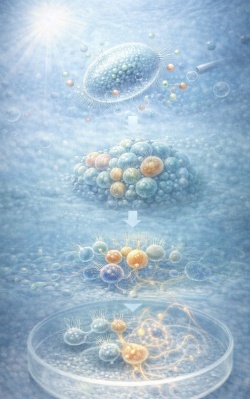
In the beginning of multicellular life, sensory functions underwent a process of further localization and organization. Thus, the cells began to group themselves in locations and become specialized to heighten sensitivity and efficiency.
Cellular Responses to the Environment
Single cells can respond to light, chemicals, or mechanical pressure through molecular reactions. These responses regulate movement, feeding, and internal balance. Even today, many organisms rely primarily on such basic sensory mechanisms.
These early responses did not involve organs or nerves. They were direct chemical interactions between the cell and its environment.
The First Specialized Sensory Cells
As organisms grew more complex, certain cells became dedicated to detecting specific stimuli. These sensory cells converted environmental signals into electrical or chemical messages.
This specialization improved efficiency. Instead of every cell responding to everything, different cells focused on different types of information.
From Sensory Cells to Sensory Organs
Sensory organs emerged when sensory cells clustered together and connected to simple nervous systems. This allowed information to be processed rather than merely detected.
The development of nerves transformed sensing into coordination. Signals could travel across the body, supporting movement and behavior.
Clustering and Signal Amplification
When sensory cells cluster, they increase sensitivity. Multiple cells responding together can detect weaker signals and reduce random noise.
These clusters represent an early step toward organs such as eyes, ears, or noses, even if their structure remained simple.
Early Nervous Systems
Primitive nerve networks allowed sensory signals to trigger coordinated responses. Instead of reacting locally, organisms could move entire bodies toward or away from stimuli.
This integration marked a major evolutionary shift. Sensory input began to influence behavior at the organism level.
Major Sensory Modalities and Their Evolution
Different sensory systems evolved to detect different forms of environmental information. Each modality reflects the physical properties of the stimulus it detects.
Not all species possess all sensory systems. Their presence depends on ecological relevance.
Chemical Senses and Early Detection
Chemical sensing is among the oldest sensory modalities. It includes smell and taste but extends beyond them. Many aquatic organisms rely heavily on chemical cues for navigation and feeding.
These senses evolved early because chemicals are abundant and informative in both water and air.
Mechanosensation and Touch
Mechanosensation involves detecting pressure, vibration, or movement. This includes touch, balance, and hearing. Early mechanosensory cells responded to physical deformation of the cell membrane.
Over time, these cells became specialized, leading to structures that detect sound waves or body position.
Photoreception and Light Detection
Light detection evolved as organisms began to use light for orientation, timing, and later image formation. Early photoreceptors detected brightness rather than shape.
Only later did photoreception develop into complex visual systems capable of forming detailed images.
Increasing Complexity and Integration
As animals evolved larger bodies and more active lifestyles, sensory systems became more complex and interconnected. Information from different senses began to combine. This integration supports behaviors such as hunting, avoiding predators, and social interaction.
The evolution of centralized nervous systems allowed sensory information to be processed in one place. Brains did not replace sensory organs but coordinated their input. This central processing made it possible to compare signals, prioritize responses, and learn from experience.
Sensory Systems in Different Environments
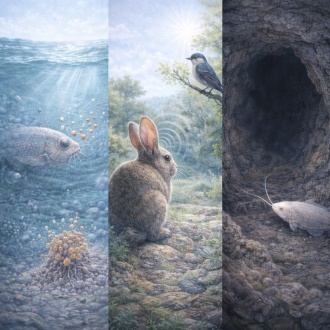
The environment plays a significant role in shaping sensory evolution. For instance, water, air, darkness, or extreme conditions all favor certain strategies over others. Sensory systems consequently reflect what information is available and useful in a given ecological setting.
Among the sensory strategies played out in water is an emphasis on chemical and mechanosensory strategies. Water is a fine conductor of chemical and vibrational messages but does not allow for long-distance vision. On land, light and airborne sound provide different sensory signals, which support the evolution of complex visual and auditory systems.
Under extreme environmental constraints, such as caves, the deep ocean, or underground, predators lose their vision over time, due to very little benefit to having eyes in those environments. Consequently, since sensory reduction functions do not in fact limit sensory acquisition, its loss actually provides an adaptive advantage.
A History Written in Sensation
The natural history of sensory systems is a story of gradual change, constraint, and adaptation. Sensory organs evolved step by step, shaped by physical laws and biological needs. From simple cellular responses to complex, integrated systems, senses reflect how life has learned to gather information about the world. Their diversity reminds us that evolution of nature favors usefulness, not uniformity.
Quick Links
Have you ever stopped to really look at an eye?
— James Lucas (@JamesLucasIT) January 16, 2026
Most of us just glance at them without thinking. But up close, the human eye is astonishing.
This photograph by Suren Manvelyan shows the iris like you’ve never seen it before. The iris isn’t just color. It’s a landscape of folds… pic.twitter.com/KDqBJyMwmm