Why Vision Varies So Widely in Nature
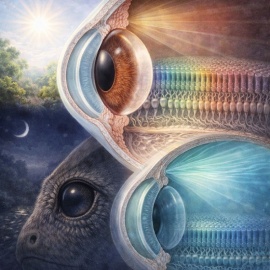
Instead of steadily progressing toward a uniform standard, visual systems evolve according to specific ecological imperatives. What may work well in one environment may be redundant or even damaging to another. Consequently, animals have evolved the most marvelous ways of detecting and decoding light.
Another influencing aspect to visual system formation is the activity pattern. This often results in species emphasizing different aspects of vision. This would include different visual traits favored by various predators, prey, or organisms that indulge in camouflage.
Given that light availability plays the major role in shaping vision. Animals living under intense light, open habitats have evolved systems that are primarily oriented towards detail and color. In contrast, those active in the dark or living in aquatic regions away from the surface favor sensitivity needed for dim light over more sharpness.
Major Types of Animal Visual Systems
Although visual systems vary widely, several broad patterns appear across the animal kingdom. These systems differ in structure, resolution, and the kind of information they provide.
No single system is inherently superior. Each reflects a balance between biological cost and functional benefit.
Single Lens Eyes
Many animals possess eyes with a single lens that focuses light onto a light sensitive surface. This design allows for relatively sharp images and supports depth perception when combined with neural processing.
The specifics vary greatly. Some species can adjust lens shape to focus at different distances, while others rely on fixed optics suited to a narrow range of conditions.
Compound Eyes
Insects and many crustaceans use compound eyes composed of numerous repeating units. Each unit captures a small part of the visual field. Together, they form a composite image.
Compound eyes excel at detecting movement and rapid changes in light. They are well suited to animals that fly or move quickly through complex environments, even if image detail is limited.
Simple Eyes and Light Sensors
Some animals rely on basic visual structures that detect light intensity without forming images. These systems are common in simpler organisms and larvae.
Even minimal vision can be useful. Detecting shadows or changes in brightness can help an animal avoid predators or orient itself within its environment.
Color Vision and Wavelength Sensitivity
Color vision adds another dimension to how animals perceive their surroundings. It depends on having multiple types of light sensitive cells, each tuned to different wavelengths.
The range of colors an animal can see often reflects ecological priorities rather than complexity alone.
Many animals perceive wavelengths invisible to humans. Some can see ultraviolet light, which reveals patterns on flowers, feathers, or skin that play roles in feeding and communication.
Others extend vision into longer wavelengths, improving contrast in murky water or low light conditions.
Specialized Visual Abilities
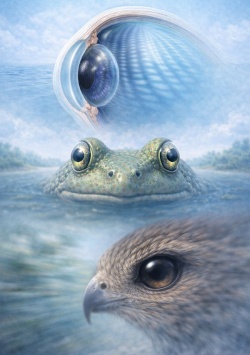
Beyond basic image formation and color detection, some animals have evolved highly specialized visual traits. These abilities often solve very specific problems.
Such specializations highlight how flexible visual evolution can be.
Polarized Light Detection
Certain species can detect the orientation of light waves, known as polarization. This ability helps with navigation, especially in open environments like oceans or skies.
Polarized vision can also reveal otherwise hidden objects by reducing glare or enhancing contrast.
Extreme Field of View and Motion Detection
Some animals have eyes positioned to provide nearly panoramic vision. This arrangement reduces blind spots and helps detect approaching threats.
Others prioritize rapid motion detection over image clarity, allowing them to respond quickly to predators or prey.
Limits and Costs of Vision
Vision is highly costly biologically, as eyes need energy for their formation, maintenance, and function. Visual information processing along neural channels also demands big chunks of growth resources. As a consequence. visual systems reflect what is necessary, rather than necessarily possible. The foundation of complex visual ability needs precise genetic exploits and, equally, enormous investment in growth. Simpler visual systems can develop where vision offers no discernible advantage.
Every visual system consists of trade-offs; improving one aspect usually entails deterioration of the other. Increased resolution may bring about reduction of sensitivity. A wide field of view may come at the expense of an equal depth of field. These trade-offs guarantee that vision never converges around a single design.
Seeing Diversity Through Evolution
The diversity of animal visual systems reflects the many ways life interacts with light. Vision evolves to meet specific needs, shaped by environment, behavior, and history. By comparing how different species see, we gain insight into evolution of nature itself, not as a march toward complexity, but as an ongoing process of adaptation, constraint, and variation.
Quick Links
Have you ever stopped to really look at an eye?
— James Lucas (@JamesLucasIT) January 16, 2026
Most of us just glance at them without thinking. But up close, the human eye is astonishing.
This photograph by Suren Manvelyan shows the iris like you’ve never seen it before. The iris isn’t just color. It’s a landscape of folds… pic.twitter.com/KDqBJyMwmm